Authors

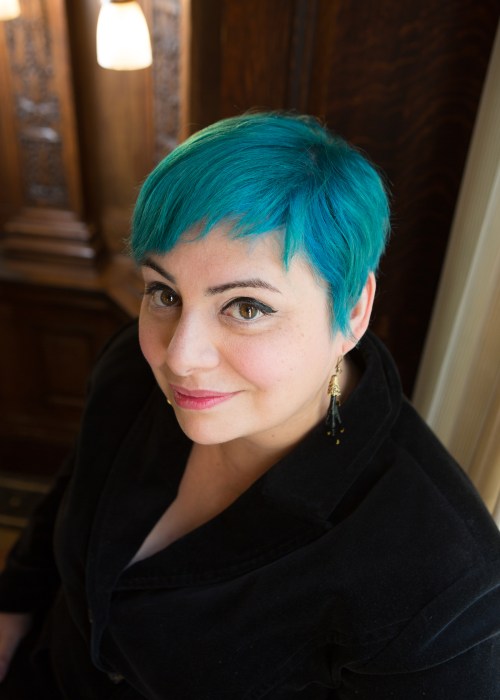
Nalo Hopkinson

Back to Author Detail

Article: I've realised that with each...

I've realised that with each novel I write, I learn some new thing that you should never try to do in writing a novel. I learn it because I try to do it, and realise too late what a difficult task I've set up for myself. Why doesn't anyone ever tell you this stuff in writing classes?


Why, for instance, did no one ever say to me: 'don't try to write an action-adventure novel in which your heroine is breastfeeding and has to save the world'? In Brown Girl in the Ring, my protagonist Ti-Jeanne has a newborn son. It was almost as though I had one. Every four hours, I had to remember to have someone feed the baby. Everytime Ti-Jeanne needed to do anything, she had to find someone to hold the baby so that her hands would be free. When she went off for the big confrontation at the end of the novel, she had to find someone who had a source of milk to babysit. And when she got back from that scene, boy was she uncomfortable for having gone a day without expressing her milk! I think I only showed the poor baby being changed once in the course of three days, too. But at least then, it was his father Tony changing him. Tony wasn't doing too well at the other aspects of his life, but he sure knew how to look after a baby.

Why did no one ever say to me, 'don't try to write most of a novel in a creole you've invented by combining two existing ones'? Well, to be honest, Samuel R. Delany did try to tell me that. But did I listen? Nooo. Every time I wanted my characters to say anything, I had to figure out how they would say it. Good thing I have a working knowledge of both Jamaican and Trinidadian speech. (I was born in Jamaica and spent years of my childhood in Trinidad.) Once I'd figured out how I wanted the characters to say it, I then had to figure out how to write it down so that my readers would understand it. My writing workshop kept me on my toes, pointing out where my grammar and sentence structure were inconsistent. Problem is, what I'd done was totally consistent with Caribbean speech; no culture in the world speaks consistently all the time. It just wasn't consistent with the written word, which is more standardized than speech. So then I had to come up with one version of my language for dialogue, and another, more formal version for the narrative. And oh, yes; there was that plot I was trying to remember to write, too.


And why, oh why did no one ever tell me, "don't try to write a novel in three different historical periods in three separate countries about which you know nothing"? By the time I was finished with The Salt Roads, I had absorbed enough material on 18th Century Saint Domingue (Haiti), 19th Century France and 4th Century Egypt to earn at least a Bachelor's degree. Do you know what amusements were all the rage amongst rich whites in 18th Century Saint Domingue? I do. Do you know where a person would empty a chamber pot in 19th Century Paris? I do. Do you know how much you could expect to pay for the most common sexual acts in a brothel in 4th Century Alexandria? I do. Why do I know all this stuff? That's a harder question to answer.

While I was researching and writing The Salt Roads, I kept promising myself that my next novel would be a simple fantasy set in the known world, where if there were anything I didn't know, I could make it up. Well, I've just started work on two new novels. Does anyone know anything about dwarf cashew farming? No? How about quantum physics, planetary mechanics, African alchemy, and spin theory? Please?

Copyright © 2003 by Nalo Hopkinson